



Vaginal Rejuvenation
Size and looseness of the vagina can affect function in intimacy and appearance.
Childbirth and aging can exert a toll on the vagina, causing laxity. Many women are concerned by the loose opening of the vagina and the stretched out vaginal canal, fearing change in intimacy for themselves and their partners.
These concerns are often also aesthetic in additional to functional in nature. The gaping vaginal opening and looseness of the labia (vaginal lips) are the most frequent cosmetic concerns. Fortunately, these concerns can be addressed by vaginal rejuvenation, a procedure that brings the vagina back to the pre-childbirth state both in look and function. Vaginal rejuvenation is usually considered an elective cosmetic procedure.
Dr. Michael Lau has been performing vaginoplasty (vaginal rejuvenation) for over twenty-five years in Seattle, combining his training and expertise in both vaginal and cosmetic surgery. He lectures internationally on vaginoplasty and has a patient base worldwide while maintaining emphasis in serving women in the Pacific Northwest – Washington, British Columbia, Oregon, Alaska and Idaho, particularly along the Portland OR, Seattle, WA and Vancouver BC corridor.
Dr. Lau performs vaginoplasty using only local anesthesia (numbing medicine) and has established a well-coordinated process that allows one-day-trip surgery not only for patients from Seattle and the Washington State area, but also those from Vancouver BC, Oregon and beyond as well.
Please view the following presentation by Dr. Lau regarding vaginal rejuvenation surgery:
Vaginal Rejuvenation should improve both function in intimacy and aesthetics.
Vaginal rejuvenation involves the rebuilding of the vaginal structures that support and contract the vagina. The muscle groups and the support tissue around the vagina are tightened in purposeful steps to narrow the caliber of the vaginal canal and the vaginal opening and to enhance the contraction of the vaginal muscle groups.
Vaginal Rejuvenation & Labioplasty Minora || Warning: Medical Content ||
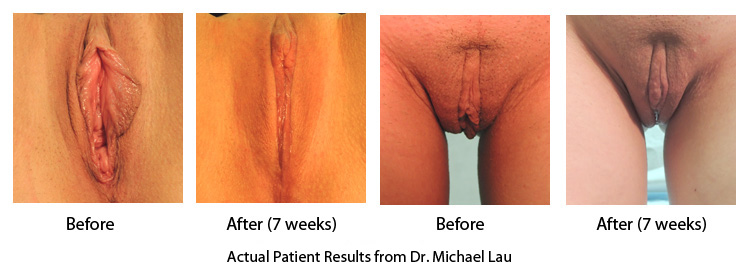
At times, excessive vaginal tissue is trimmed off and tightened. Vaginal rejuvenation can often be supplemented by labiaplasty (labioplasty) to restore a more youthful, pre-childbirth appearance of the genitalia.
It is important to be able to improve both the aesthetics and function of the vagina with vaginal rejuvenation. After all, the vagina is an important organ for intercourse, critical in generating satisfactory intimacy for both partners. There are essential structures, such as the erectile tissues involving the clitoris complex, the bulbs, and the dense nerve plexus at or in the proximity of the distal anterior vaginal wall (the lower part of the front vaginal wall close to the vaginal opening), that are important in contributing to arousal and orgasmic response. Preservation and enhancement of these structures will help to improve function in intimacy with vaginal rejuvenation. A thorough understanding the vaginal anatomy and physiology, along with meticulous, sound plastic surgical technique are essential to achieve optimized aesthetical and functional results with vaginal rejuvenation and labioplasty.
Vaginal Rejuvenation can be done in the office surgical suite with local anesthesia.
With vast experience in many types of vaginal reconstructive and plastic surgery over 25 plus years, Dr. Lau is able to perform vaginal rejuvenation and labioplasty with optimal patient comfort using local anesthesia (numbing medicine) in his office surgical suite. By not needing general anesthesia (going to sleep) or spinal anesthesia, the patient avoids additional anesthetic risk and has a faster and easier recovery and a better sense of control. Furthermore, there are substantial cost savings. Of course, if for some reason the patient wants general anesthesia, then Dr. Lau will perform the surgery at Swedish Edmonds Hospital next to his office.
Vaginal Reconstructive || Warning: Medical Content ||
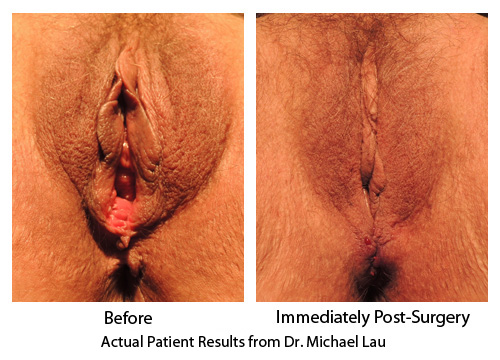
To optimize the patient’s comfort during the vaginal rejuvenation, the following processes are used:
- One hour before surgery, an oral sedative is given to the patient. The patient will have much less anxiety, but is awake enough to start watching a movie of her choice. An intramuscular injection of a non-narcotic pain medication is also given. Local anesthetic gel is then applied to the vaginal area to numb the skin so the patient will not feel much with the local anesthetic injections to be given during the vaginal rejuvenation and labioplasty.
- Local anesthesia injection is used to numb the vaginal area before and during the vaginal rejuvenation and often associated labioplasty. Since the skin has been numbed previously with the local anesthetic gel, the discomfort of the injections is minimized. There should be no pain felt otherwise during the vaginal rejuvenation.
- No laser is used, and electric cautery is used sparingly and judiciously only for larger blood vessels in order to minimize any nerve damage that might affect sensation and function.
- With the use of a mixture of long acting and short acting local anesthesia, the patient should have no pain at all at the conclusion of the vaginal rejuvenation and immediately afterwards for up to one plus hours. The patient will then maintain her comfort with oral pain medication, usually a narcotic based medicine. With pain medication and an ice pack to the vaginal area (for the first 48 hours), most patients find the post-operative discomfort rather manageable after vaginal rejuvenation.
Vaginal Rejuvenation 2 || Warning: Medical Content ||
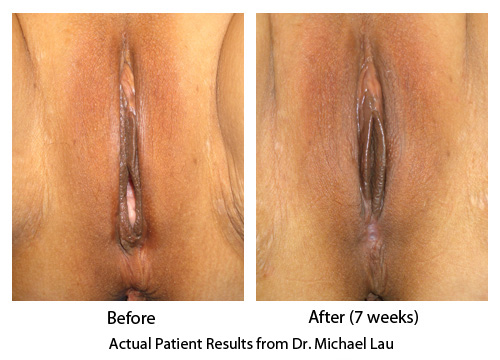
Expectations and limitations after vaginal rejuvenation
- The patient should use an ice pack to the vaginal area for the first 48 hours after vaginal rejuvenation. She will then switch to warm moist heat local treatment four times a day after the first 48 hours. With the local treatment and oral pain medication, patients usually find the post-operative pain manageable. Most patients can transition to non-narcotic pain medicine within a few days by gradually weaning off the narcotic medication.
- Once the patient is off narcotic pain medication, she can resume driving.
- There is no diet restriction after vaginal rejuvenation. However, stool softener and food that encourages soft bowel movements are strongly recommended.
- The patient can move around and walk the day after vaginal rejuvenation unless she is overly sedated by the narcotic pain medication. She can shower the day after vaginal rejuvenation and take bath a week after the surgery.
- Most patients can return to desk jobs within one to two weeks after vaginal rejuvenation.
- The patient should not have any vaginal intercourse or other activities for six weeks after vaginal rejuvenation.
- The patient should refrain from lifting more than 20 pounds for six weeks post-surgery.
- While the patient can walk and do non-impact exercise, such as treadmill, elliptical machine, etc. a few days after vaginal rejuvenation, she should avoid any high impact or jarring exercise four to six weeks, depending on healing progress.
American College of Surgeons

American Academy of Cosmetic Surgery

American College of Obstetricians & Gynecologists